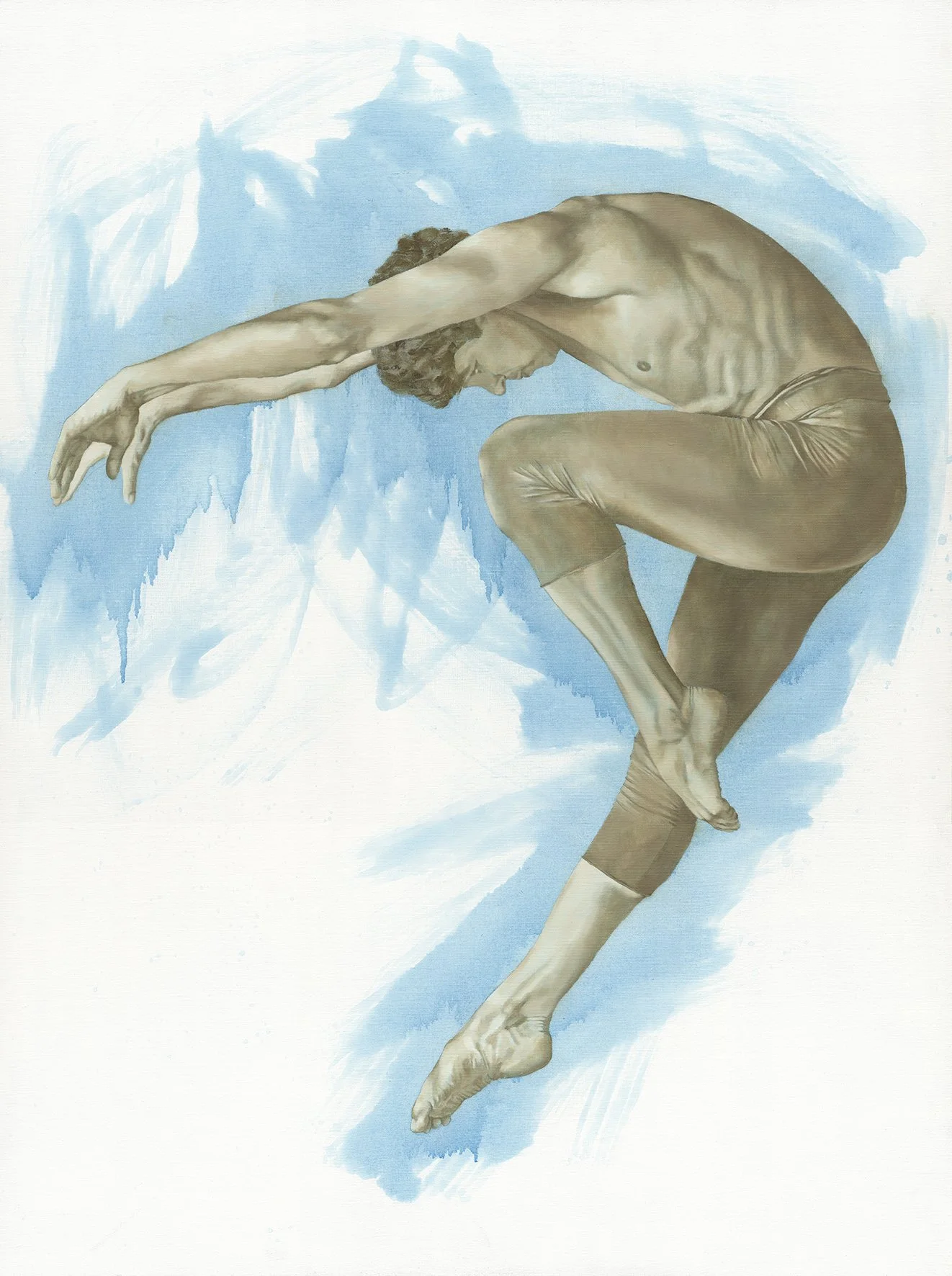
Reaching Flight 1, oil underpainting, 2026
Why an accident needs a method
Behind the dancer in Reaching Flight 1 there is a passage of thinned blue that did not stay where I put it. A thin layer of paint, laid onto an upright canvas, gathered and began to travel, finding its way down the weave of the linen along whatever lines gravity happened to prefer. I did not plan those runs, and I could not have placed them so well if I had tried. Runs like that can undo an afternoon's work. These became one of the things I value most in the painting, and it makes me wonder why it went that way and not any other.
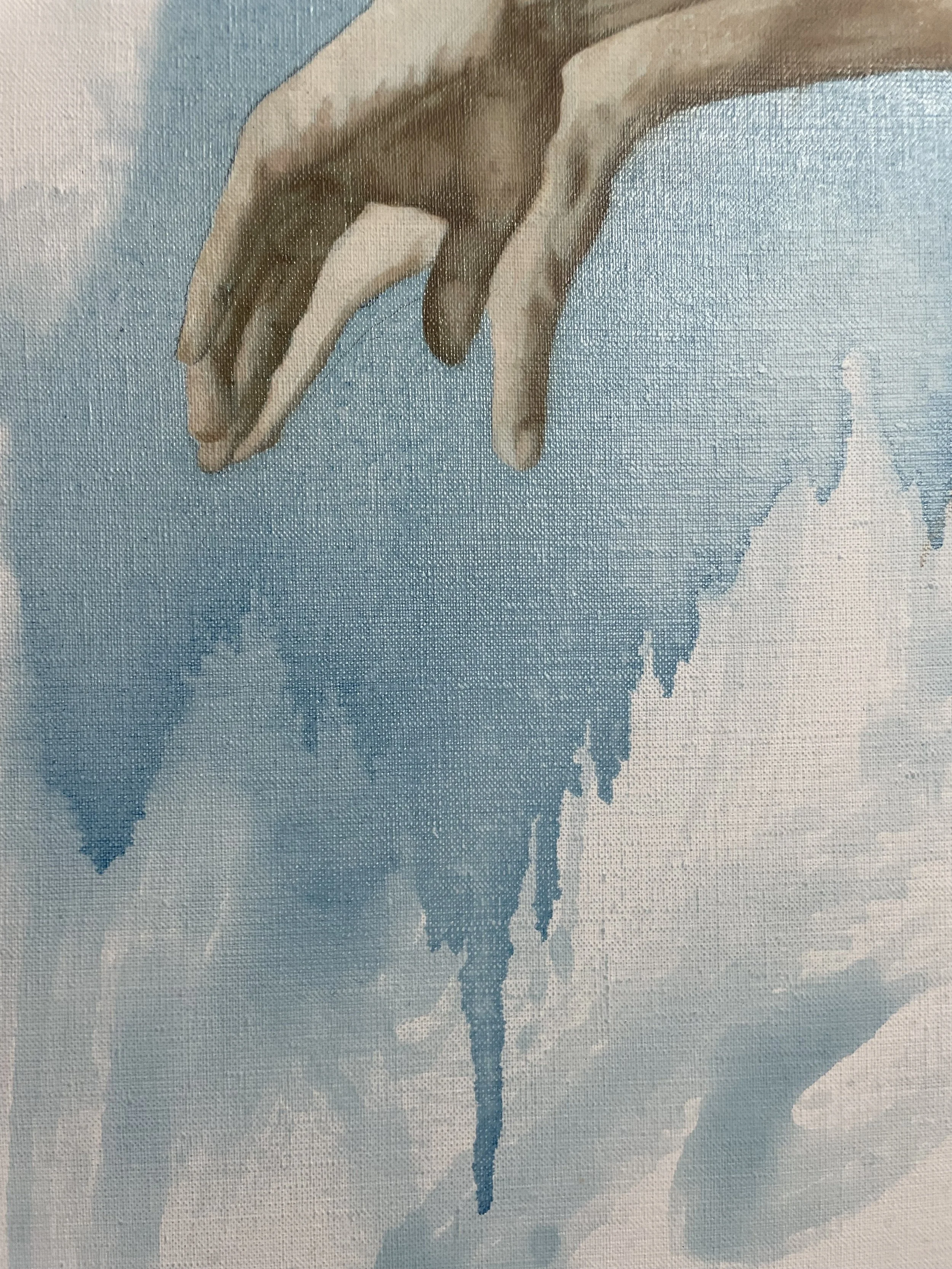
Reaching Flight 1, detail: the runs, which were not planned
The easy reading of a practice like mine (layered, slow, built on a classical training that took me years to learn) is that it exists to keep accidents out, which would make it an odd method to point at the body in movement, a subject made almost entirely of chance. I thought about that reading recently, and found that I disagreed with it. Chance gets in throughout the process: micro-decisions that don't come out as
planned, gestural movements, sudden ideas thrown in within the envelope of the process... The method isn't something the accident has to survive. It is what makes the accident mean something.
Keith Tyson put the first half of this very simply, in conversation with the astrophysicist Pedro Ferreira for Ursula magazine this summer: “Chance has always been part of art. That energy of randomness, the accident, is what gives things life.” The second half interests me more. You can only recognise a surprise against something you expected. Chance with no structure around it is noise; inside a structure it becomes information, and that is why scientists, whose business is being usefully surprised, insist on method first.
The technique
The method I work with has a name, technique mixte: the Victorian revival of the way early Renaissance painters built up a picture, which I call on throughout my practice.
In the studio it is a sequence: a toned ground, a monochrome grisaille that settles the values, an imprimatura, an underpainting, and then the glazes, each stage narrowing what the next one can do. By the time colour arrives, a great many decisions have already been made, and the ones that remain can be made freely because the others are no longer in question. In the rehearsal room it is a protocol, a way of working alongside choreographers and dancers that I have been refining for some years, which decides what I look at, when, and what I carry back to the studio.
Take the methods away, and you can see what they are doing. A glaze laid with no grisaille beneath it has nothing to glow against, because light needs a dark to be read against. A rehearsal watched with no protocol becomes a blur of movement I can admire and can't use. Everything can become a mess, and a mess is a long way from freedom.
Ally Fallon says this more plainly than I can, in the statement accompanying If You Were Certain, What Would You Do Then?, which won the John Moores Painting Prize in 2025. His paintings begin with a tiled floor, the product of a long preparatory process of drawing and planning, and then, on top of it, a gesture made in seconds, “this moment of action that you get one shot at”. Remove the floor, he writes, and “the gestures would become flat, the painting would have no gravity, and as a result, the relationship between the marks would float away.” And later: “counterintuitively, by following this rule, it allows me more freedom in the painting.”
Chance, inside the envelope
Inside all that structure, chance comes in continuously and in small amounts: a brush might be loaded slightly differently from the last; a gestural movement could arrive with more force than I intended; an idea could turn up mid-session and be thrown in before I can discount it. Each happens within the envelope of the process, and I can only see it as a departure because the envelope is there.
In the same conversation in Ursula, Ferreira offered an image from physics. Before it is measured, a quantum system holds many possible states at once; the act of measurement locks one of them in. Tyson's reply was, in effect, the painter's version: “Once it's there, that's what it is.” That is exactly what a mark is like. Until the brush meets the canvas, many marks are possible; afterwards there is one, and it cannot be taken back, only built upon or buried beneath later layers. Classical method is, among other things, a way of preparing for that moment, so that when the possibilities collapse into a single stroke (or movement), the stroke lands somewhere able to hold it.
The unruly
Then there are things that don't work within the method at all. They behave according to rules of their own, and they can upturn it entirely. Gravity is one: the way it pulls a dancer around in the air, deciding the arc of a fall well before any choreography has a say. Paint is another: the way it moves across a canvas once it has left the brush.
The odd thing is that they are perfectly lawful. Paint does exactly what its viscosity, the surface tension of the medium, the absorbency of the ground and the pull of the earth dictate, every time and without deviation; it is the most obedient thing in the studio. It just obeys laws that aren't mine. Those blue runs in Reaching Flight 1 were obeying those laws to the letter.
These should be observed, I think, more than managed. But gravity and paint remain materials. They often overturn my intentions, and that still doesn't make them collaborators: collaboration, as I practise it, happens between people.
Two trainings meeting
I now think this is also why my collaborations with dancers work.
I generally choose to work with dancers and choreographers who have had some, or extensive, classical training, which they have then, in their turn, set out to disrupt. They call on the same idea of structure, which is inherent in how their trained bodies work; and in moving towards more contemporary systems, they themselves open the door to more exploratory work. Classical training is a preference rather than a
rule. What matters is a formed training of some kind (and there are many kinds, each with its own rigour) which the dancer has then chosen to work beyond.
You could say that a dancer's training lives in the body while a painter's is a procedure to be followed. I don't think that's true. Through years of repetition and study, my methods have become as ingrained in my physical approach to the canvas as a dancer's are in their approach to a performance space. An atelier installs memory in the hand much as a ballet school installs it in the whole body: hundreds of hours, until the method is held rather than consulted. Bergson called this habit-memory: the past held in the body as a skill. Neither of us can put our training down, and neither of us is entirely content to stay inside it.
So what I find meeting in the rehearsal room is two formed systems, each installed over many years and each now being deliberately opened - fortuitous accidents and the unruly allowed in. I think the work comes from that, more than from any shared interest in movement alone.
What I haven't resolved
A method that protects chance can also domesticate it. If every window for accident is designated in advance (here the brush may wander, here the glaze may run), then the accidents that arrive are the ones I was expecting, and that is variation rather than surprise. Tyson touches on this when he speaks of “a kind of configuration space of all the possible artworks that could exist”: to define the space and set its parameters is also to choose what cannot happen inside it.
My first answer was the unruly. Gravity and paint can overturn the method entirely, and they lie beyond my control. But that answer has a weakness. An artist who decides that here, in this passage, the paint will be allowed to do what it does has arguably domesticated that too, turning the unruly into one more designated window. The runs in Reaching Flight 1 were a genuine accident; but leaving them there was a decision, and the moment I made it, the accident became part of the method. Whether anything genuinely wild can survive a method this deliberate, or whether the wildness has to arrive from outside
it (from another person, perhaps the viewer, and their own formed system), I don't yet know. The next body of work may tell me.
Writing as part of the enquiry
Writing pieces like this has become part of the practice itself. Trying to explain to you what I do, what I am trying to do, and what I would like to do is itself a way of finding out: a kind of collaboration with whoever happens to be reading. I'll be writing here regularly as the work develops.
If you would like to follow the enquiry as it unfolds, do subscribe. Subscribers hear first about new work as it leaves the studio, about exhibitions, and about the occasional open studio here on the north coast of Cornwall.
Rachel
Sources
Bergson, Henri. Matter and Memory. 1896. Translated by Nancy Margaret Paul and W. Scott Palmer, 1911.
Fallon, Ally. Statement for If You Were Certain, What Would You Do Then? John Moores Painting Prize, 2025.
Tyson, Keith, and Pedro Ferreira. “An Artist and An Astrophysicist Walk Into a Bar.” Ursula, no. 17 (2026). Hauser & Wirth.
Press, commissions and acquisitions: info@rachelfoister.com